
Other’s gaze seems relevant, but just how important? (DA study)
Infants of a social species occupying an ecology where knowledge and smarts reap the largest benefits, human babies, are likely to use others for figuring out what to learn about. Even when we do not actively play with them or teach them, they are observing us and tracking our actions and attention.
What we studied and how
Previous research showed that babies do not only follow gaze, but also learn more about an object if it is the target of someone’s gaze. In previous studies we found evidence that not only do they learn more about an co-attended object vs. other objects, but they seem to overlearn the state of the co-attended object better than a new state of the same object they see only by themselves. That is, they remember less of what they just saw themselves but more of what they previously saw with someone else, even if it is the same object (Manea et al., 2023). The state was one of two hiding locations: 8-month-old infants could see an animated character (the agent) watch a ball being hidden at location A. Then the agent leaves the scene and babies see, only by themselves, the ball transferred to location B by a conveyor belt. We measured the amount of looking time at revealing each location empty, under the assumption, common in infants studies, that they show more interest in things they don’t quite understand: here expected vs. unexpected absence.
In the current study, we wanted to test the limits of this other-reliance with a simpler design. We show a single hiding event while the agent was also present. Babies were assigned to one of two conditions: in Sane Agent, the agent attended to the ball during the hiding event. The critical test is what we jokingly call the Deranged condition, the animated agent looked toward the opposite side. The ball goes towards A but the agent looks to B. We again show two absences, locations A or B, and measure which absence is more interesting to the babies. Do they just care about the targets of others’ attention, irrespective of what the true state is?
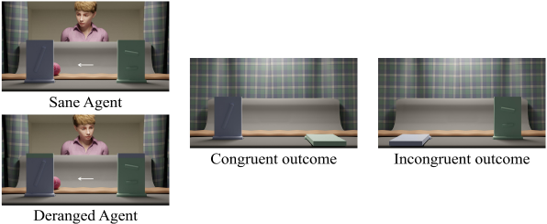
Results
Preliminary findings point to longer looking time to the location where the Deranged agent looked. At the same time, in the Sane Agent condition, infants looked longer to the reveal at the location where nothing happened as well: outcome congruent with reality (expected ball absence). This renders the pattern of results uninterpretable with respect to the hypotheses under test. Infants’ attention seemed to be driven here simply by something happening at the location where there was no action before. We are currently trying to get to the bottom of this issue by testing together with a partner lab in Germany a new version of the original that asks the same question, what is the relative importance of the others’ attention for infants memory.
Researchers
| Name | Title | |
|---|---|---|
| Peter He | PhD Student |
|
| Velisar Manea | Academic Staff |
|
| Victoria Helen Southgate | Professor |
|
