
Does the perspective of others affect what 11-month-old infants learn?
In this study we investigate whether 11-month-old infants more efficiently remember objects that others attend to.
When infants begin to acquire knowledge and expertise about the world surrounding them, they are faced with countless situations and objects they might attend to. For this learning task to be solved efficiently, they must direct their efforts to that which is advantageous to learn. In response to this, it has been argued that infants are altercentric. This implies they readily attend to social partners visual perspective, and more efficiently learn and remember the targets of others attention. This may allow infants to easily identify advantageous sources for learning, as that which others attend to, already has been deemed interesting and relevant.
What do we investigate and how?
In this study, we investigate whether babies better remember objects that others have previously attended to, compared with objects that have not been attended to by others.
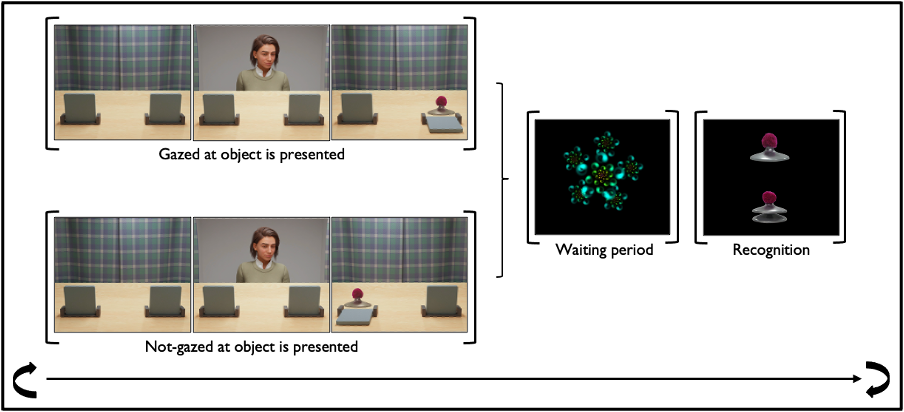
We present animated videos of a person looking at one of two objects, both of which are hidden from the baby. The person then disappears, and we alternately present the object the person previously gazed to or the object the person did not gaze to. We then play an abstract animation and some music for some time to pass, so we can test infants’ memory for the objects. Then we present the object again together with a new but similar object. If babies remember the object they saw, we expect them to differentiate between the old and new objects. We can investigate this with our eye-tracker, which tells us where on the screen the babies are looking, and if on average babies look more to the previously seen, or the previously unseen, objects.
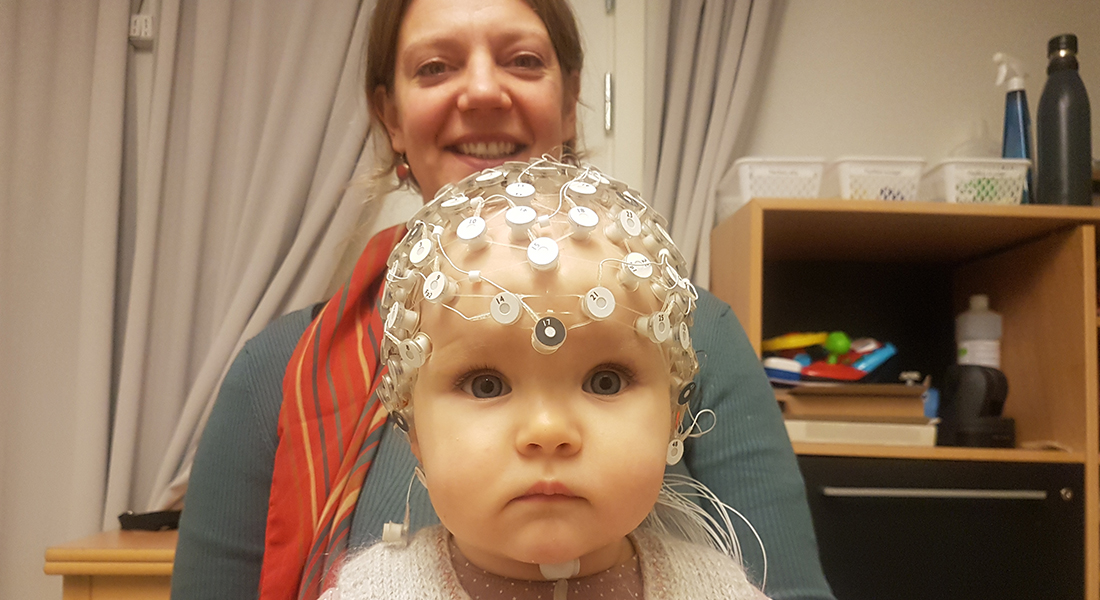
If babies better remember the objects previously attended to by a social partner, we also expect them to have been processed differently. Therefore, we also investigate how the brain reacts to observing these objects. We do this with EEG (electroencephalography), that allows us to measure specific brain rhythms that have been associated with learning.
In sum, we aim to uncover whether children use the perspective of others to identify relevant sources of learning, and in turn, dedicate their learning efforts to these targets.
Researchers
| Name | Title | |
|---|---|---|
| Dora Kampis | Associate Professor |
|
| Helle Lukowski | Academic Research Staff |
|
| Katarina Begus | Assistant Professor - Tenure Track |
|
| Velisar Manea | Postdoc |
|
| Victoria Helen Southgate | Professor |
|
Affiliated
| Name | Title |
|---|---|
|
Bjørn Dahl Kristensen
|
Research intern |
Funding

The study is supported by European Research Council (ERC).
Study period: Autumn 2022 - Autumn 2023
PI: Dora Kampis