
Synchrony in caregiver-child interactions across neurodiversity (SYNCC-IN)
Interpersonal synchrony is the alignment of emotions, behaviors, and even biological rhythms between individuals. In the context of caregivers and children, it happens when they share matching facial expressions, coordinated movements, or even synchronized heart rates and brain activity during meaningful interactions. These moments of connection are the foundation for trust, communication, and learning.
What we studied and how
This study investigates how the interactions between caregivers and children relate to cognitive and emotional development, particularly for children with diverse developmental needs. The project financed by the EU Horizon programme, is a collaboration between Universities in Poland, Italy, Germany and Denmark (our centre). In Denmark and Germany neurotypical children are invited to take part in the study. To be able to investigate differences in development, a group of children diagnosed with ASD, as well as children born prematurely, are equally taking part in the study in Poland; preterm babies are also being tested in Italy. By investigating how synchrony in parent-child dyads works across behaviour, physiology and the brain, the project can help generate knowledge that is relevant to families, educators, clinicians and professionals working with children. Ultimately, SYNCC-IN seeks to build knowledge that can support healthy, happy development outcomes for children across Europe.
For children, synchrony with a caregiver is relevant for a healthy development. When a caregiver responds to a child’s cues – like calming them when they cry or sharing in their joy – it strengthens the child’s ability to eventually regulate their own emotions and builds their sense of security. Caregiver–child synchrony is widely recognized as a fundamental component of early relational development, with significant implications for attachment, emotional regulation, cognitive growth, and long-term mental health.
Procedure
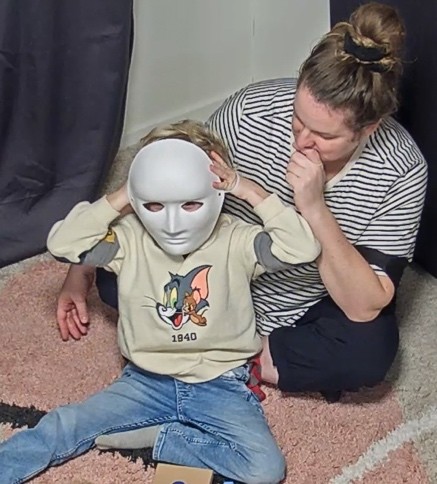 In Denmark 53 Danish families and 8 English-speaking families with children between the ages of 3.5-5.5 years, participated from August to December 2025. First, caregiver and child took part in the SECORE procedure, which was recorded on video. Dyads participated in a procedure with three main phases, each focusing on either cognitive, motivational, or emotional regulation. This task was designed to assess how parents and children manage challenging situations, both together and individually. Self-regulation and joint regulation are important at all ages, including for children, and contribute to well-being. We wanted to better understand how we can best support this, and which factors may play a role. As the aim was to assess how challenges are handled, it involved a small set of situations that may be mildly uncomfortable. Before the start of the study, they were also given a pair of accelerometers to wear on the back of the arm so that we could measure their movements.
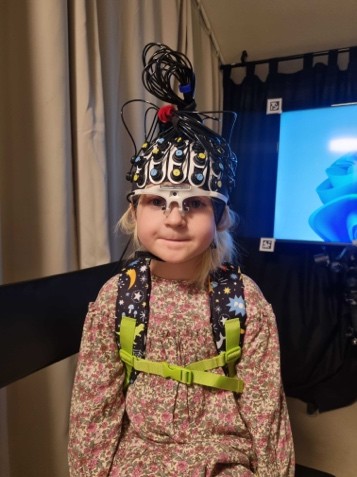
Once the SECORE procedure was complete, parent and child were equipped with lightweight fNIRS caps, (fNIRS stands for functional infrared spectroscopy, which is a non-invasive neuroimaging technique that measures changes in oxygenated and deoxygenated blood flow), to collect data on brain activity, and were also asked to put on eye-tracking glasses, allowing the examination of the coupling of pupil dilation, which has been shown to synchronize during shared attention. This part of the project aims to measure the neurophysiological responses of the child and the caregiver during a video-co-viewing session. During this movie-watching session, participants were seated next to each other and they were shown three consecutive animated videos with some emotional or social content. Our question here is: does dyads’ brain response show synchrony during watching these events, and does this relate to their emotional regulation?
After the cartoon viewing, participants were seated facing each other and were asked to engage in short conversations. First they were asked to either talk about the secore session or the cartoons, which could lead to discussions about the emotional content. For the second conversation they were asked to talk about a recent event, that they had both taken part in and both remembered and that was a one-off event.
Additionally, participants were also sent links to online forms for a few questionnaires (general demographics, temperament questionnaire(s), a questionnaire on general development and one on impulse control in dyads between caregiver and child), to understand children’s development.
Researchers
| Name | Title | |
|---|---|---|
| Dora Kampis | Associate Professor |
|
| Helle Lukowski | Academic Research Staff |
|
| Victoria Helen Southgate | Professor |
|
Funding

The study was supported by the European Union, Horizon programme.
Study period: August 2025 - December 2025
PI: Dora Kampis