
Synchrony, oxytocin, and the self
Caregiver-infant synchrony, the harmonious coordination of behaviours and rhythms between a caregiver and an infant, is a fundamental aspect of human interaction that plays a crucial role in shaping early social cognitive development. From birth, infants and their caregivers engage in synchronised interactions, such as mirroring movements, sharing facial expressions, and vocalising in unison. This synchrony not only enhances bonding and attachment but also promotes positive outcomes in self-regulation, empathy, and social skills.
 |
 |
What we studied and how
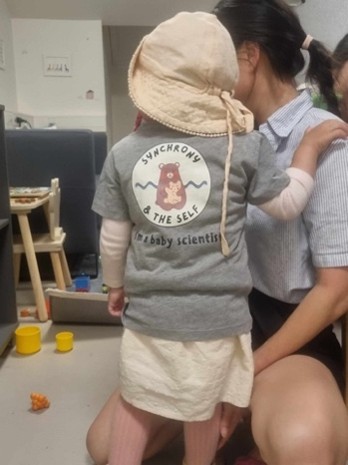
In this study we test a novel hypothesis that synchrony may actually suppress the development of self-awareness, a critical milestone that typically emerges around the second year of life. This inhibitory effect is attributed to the fact that synchrony fosters self-other integration, a state in which the boundaries between the self and the other are blurred.
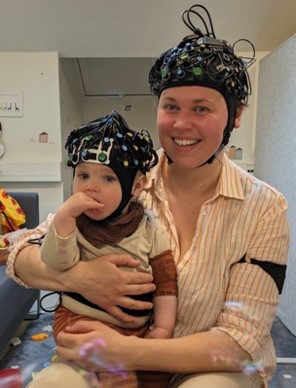
To test this hypothesis, we began a longitudinal study in September that follows 120 infants and their caregivers from 8 months to 12 months to 18 months of age. At each visit, the infant-caregiver dyads engage in 10 minutes of free play and participate in a number of behavioural tasks. We also use functional near-infrared spectroscopy (fNIRS) to measure brain activity at rest and during play. Infants and caregivers are also given a pair of accelerometers to wear for one week at home, which allows us to go beyond traditional observation-based approaches to capture subtle fluctuations in movement and timing that are indicative of synchrony. By tracking synchrony over extended periods of time, we aim to examine its relationship to brain activity and oxytocin levels, a neuropeptide that plays a key role in social bonding and emotional regulation.
The findings of this research have the potential to further our understanding of the role of infant-caregiver synchrony in early social development. By unravelling the mechanisms by which synchrony influences self-awareness and social cognition, researchers can identify new targets for interventions to promote healthy social development.
Researchers
| Name | Title | |
|---|---|---|
| Dimitris Askitis | Guest Researcher |
|
| Emanuela Yeung | Assistant Professor |
|
| Helle Lukowski | Academic Research Staff |
|
| Velisar Manea | Postdoc |
|
| Victoria Helen Southgate | Professor |
|
Funding

The study was supported by European Research Council (ERC).
Study period: August 2023 - October 2024
PI: Emanuela Yeung