
How do infants understand other people? (Attribution study)
Infants are very good at learning from other people’s actions. When they see an agent repeatedly choose one object over another, they may not only remember that specific choice but also infer something about what the agent likes or prefers. Previous studies suggest that infants can sometimes generalize an agent’s choice from a single object to a broader category. For example, if an agent chooses a doll but not a truck, infants may expect the agent to choose a new doll rather than a new truck later on. In this study, we ask whether infants truly represent an agent’s preference at the category level, or whether they are simply responding to perceptual similarity between objects.
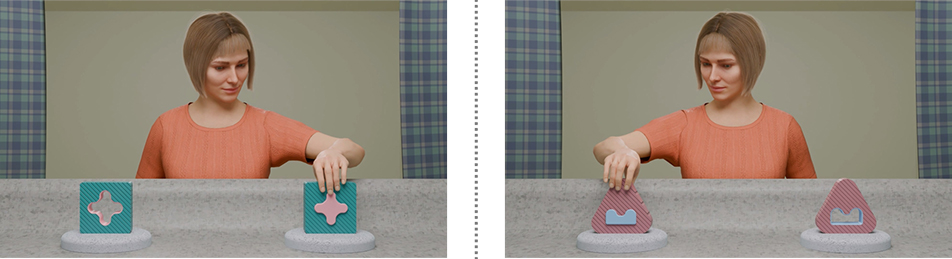
What did we investigate and how?
In this study, we show infants an agent who repeatedly chooses between two visually similar novel objects but from different topologically defined categories, filled vs hollow. The agent consistently chooses one object, for example the hollow one from the other. At test, infants then see the same agent choose between two new objects, which are again visually similar but differ in the same way: one is filled and one is hollow. If infants expect the agent to choose the new object from the previously preferred category, this suggests that they have attributed a category-level preference to the agent.
This design allows us to examine infants’ category-level preference attribution without relying on familiar object names, labels, or prior knowledge about object kinds. It also helps us reduce the possibility that infants are simply matching the test object to the previously chosen object based on obvious surface similarity. Instead, we can ask whether infants can use a deeper topological distinction – filled versus hollow – to identify which category the agent prefers.
To measure infants’ expectations, we use both looking time and pupillometry. Looking time allows us to examine whether infants look longer when the agent acts in an unexpected way. Pupillometry provides an additional measure of infants’ cognitive processing, as changes in pupil size may reflect how strongly infants respond to different outcomes.
Researchers
| Name | Title | |
|---|---|---|
| Peter He | PhD Student |
|
| Velisar Manea | Academic Staff |
|
| Victoria Helen Southgate | Professor |
|
