
Theta2: 8-month-old infants seem to appreciate what others find interesting
Long before they can speak, infants are aware of what the people around them are paying attention to. A wide range of studies shows that infants learn more about an object when another person has looked at it first – as if that person’s attention marks the object as worth knowing about.
Our own research suggests that this tendency may be surprisingly strong: in a previous study, eight-month-old infants who saw an adult look toward a hidden toy sometimes remembered it being where the adult had directed their attention – even after seeing it moved to a different location.
What we studied and how
If infants treat the objects of others’ attention as particularly valuable, we should be able to see this in the brain the moment such an object appears. We focused on a brain rhythm called theta activity, which we measure based on the electrical activity we record from the scalp using an electroencephalography (EEG) cap. Theta has been linked to a kind of “readiness to learn” and tends to become stronger when something is being stored in memory.
Eight-month-old infants watched a person on a screen look toward one of two screens, each of which concealed an object. The person then disappeared, and one of the screens was lowered to reveal what was behind it. It is important to note that the children never actually saw the adult look at an object – they could only infer that the adult had directed their attention toward one location. We compared the brain’s response depending on whether the revealed object came from the location that had been looked at (“cued”) or from the other one (“uncued”). Later, in a brief memory test, each object reappeared alongside a slightly altered version of itself, and we measured which one the child preferred to look at.
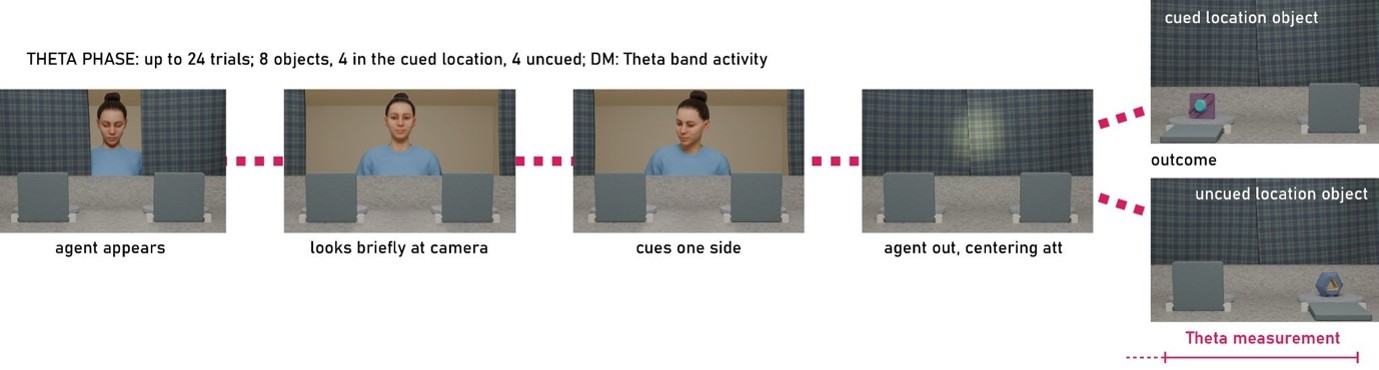 We found increased theta activity at the back of the head (the visual areas) when an object was revealed at the location where the adult had directed their attention. And the stronger this reaction was, the more the child later preferred the originally cued object – a sign that they remembered it. Objects from the location that had not been looked at were also remembered, but in a different way: in these cases, the children tended instead to prefer the new, altered version.
Taken together, these results point to two things happening simultaneously. Infants remember objects regardless of whether someone else has looked at them or not – but when an object has been the focus of another person’s attention, they seem to attach special value to it and demonstrate this by choosing to return to it later. In other words: as early as eight months of age, what others find worth paying attention to helps shape what your child considers worth knowing about.
We are currently testing a new version, theta3, the difference with this new version is that the person never sees the object; the person looks to one of the sides of the screen and then disappears, and only then does an object appear on the screen – so young children, if they draw any conclusions, cannot conclude that the person has just looked at the most attractive of the two objects or has a preference for that object. Finally, as in Theta 2, we investigate whether the child can recognize the objects by showing them two objects, one of which they have seen before.
Researchers
| Name | Title | |
|---|---|---|
| Helle Lukowski | Academic Research Staff |
|
| Velisar Manea | Academic Staff |
|
| Victoria Helen Southgate | Professor |
|
