
Psychology
27 November 2025
Why protests can bring people together across political divides
Psychology
How can people with diametrically opposed views suddenly stand shoulder to shoulder in protest? Researchers from Copenhagen, Oslo and Mainz have investigated this question. The starting point is the COVID protests, which were driven by three unifying strategies.
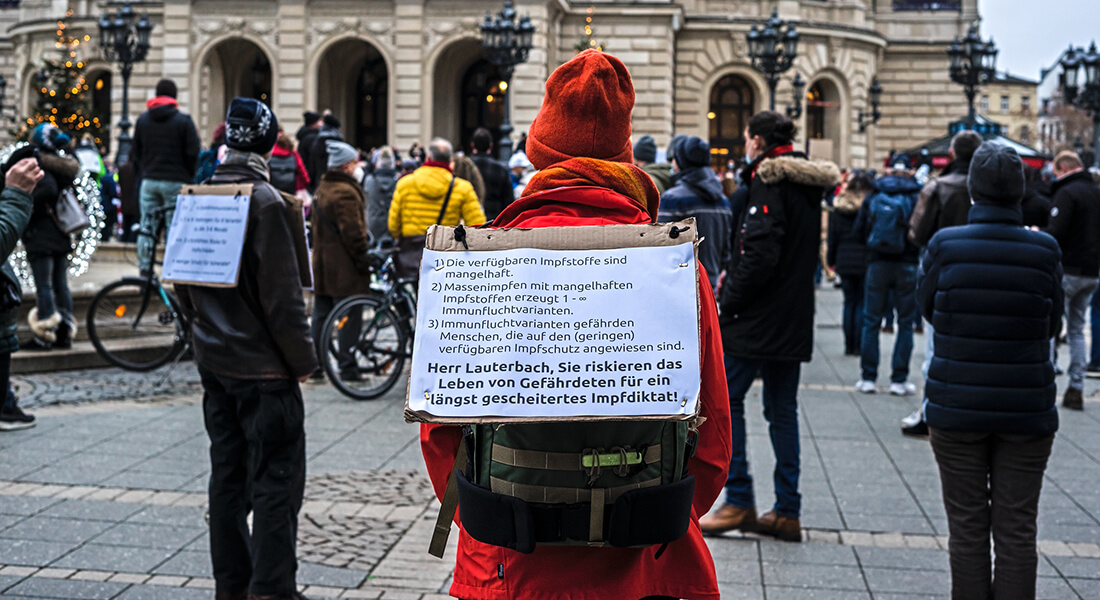
A new international study explains how alliances between groups from the far right and left can be formed with protests in mind. These kinds of alliances between groups with opposing ideologies, typically united against a common enemy, are called Querfront.
‘Today, we see alliances between nationalist neo-Nazis and nationalist black movements, united in their hatred of Jews. Here, opposition to a particular group becomes the common bond that brings two otherwise very different groups together,’ says Milan Obaidi, associate professor at the Department of Psychology at the University of Copenhagen.
Together with fellow researchers in Oslo and Mainz, he is behind the study, which has been published in the scientific journal British Journal of Social Psychology.
Common goals – common identity
The researchers' starting point is the mobilisation against the authorities' restrictions during the COVID-19 pandemic. The researchers analysed 11 protest observations and 30 in-depth interviews with participants in the German anti-lockdown movement.
‘Most of the participants experienced the movement as ideologically diverse, but they found ways to deal with the differences,’ says Milan Obaidi.
The researchers have identified three main reasons why the COVID demonstrations were able to unite the extremes. The first is about shared identity: the protests were legitimised through fundamental identities – such as “human beings” or “critical thinkers” – with a common goal of restoring the constitution.
‘These kinds of alliances arise from a cost-benefit logic: if an ally increases the chance of achieving the goal, ideological differences are tolerated,’ points out Milan Obaidi.
Defending and embracing each other
Another key strategy is the defence of allies. During the COVID protests, participants downplayed extreme views among fellow protesters and criticised the categorisation by the media and authorities. Finally, the participants managed to embrace the diversity of the protest movement. Some saw diversity as a strength as long as the protest remained non-violent.
‘We see that when people experience a major threat – such as a pandemic – ideological differences become less important than survival and freedom. It's about creating a sense of “us”, even with those you would normally fight against,’ explains Milan Obaidi.
He points out that the COVID pandemic did not only threaten our physical survival. It also threatened our values and social structures:
'Lockdowns affected our national identity and social relationships, and the pandemic also posed a threat to economic survival, as many businesses and individuals suffered heavy losses. Therefore, one cannot simply say that ideology becomes less important than survival. The pandemic threatens us on several levels – our biological, economic and value-based existence,' Milan Obaidi notes.
Risk of radicalisation
Overall, the researchers assess that Querfront movements can be both a source of unity and a risk for radicalisation. When the crisis is over, these alliances often dissolve – and can leave fertile ground for extremism.
‘It is crucial to understand these mechanisms because they do not only apply to pandemics. We see similar patterns in climate protests and digital rights movements,’ notes Milan Obaidi.
The study points out that future efforts to combat polarisation should combine social identity theory with insights from coalition psychology.
‘This can help build bridges between groups – without opening the door to extremism,’ concludes Milan Obaidi.
You can read the entire study, ‘The psychology of Querfront tactics,’ here.
Contact
Milan Obaidi, Associate Professor
Department of Psychology
Email: milan.obaidi@psy.ku.dk
T: +45 35 32 91 76
Simon Knokgaard Halskov
UCPH Press
Email: skha@adm.ku.dk
M: +45 93 56 53 29